
I have loved internet marketing and the whole idea of creating something out of nothing ever since I was a kid. However, I think as more and more websites pop up, there is a huge misconception about what it actually takes to succeed online. There is no such thing as an overnight success. Being successful online takes a lot of hard work and, most important: failure. Yes, it usually takes many failures to succeed!

Today I’m going to share with you some of the many failures that I’ve gone through to get to where I am today. Fair warning, there are a lot.
It started like a drug
If you’ve ever read my bio, you already know that I’ve been an entrepreneur since around the 6th grade. I started reselling CDs and DVDs on eBay and this allowed me to buy my very first laptop in cash. This was back in the good ole days of NetZero dial-up. 😂 Boy, I don’t miss those days. Now we live in an age where we just tether our phones when our cable goes out. Crazy!
The feeling of paying for that first laptop with nothing other than my skills on the internet was a feeling that even today is like a drug. Only other entrepreneurs or internet marketers will probably be able to relate. I genuinely believe entrepreneurs and internet marketers are born with a certain mindset that you can’t turn off. Trust me, some days I wish I could. Some of my family growing up probably did too, haha.

First failure (it didn’t last)
By the time I was in 8th grade, I was reselling CDs and DVDs on eBay full time (or as full time as you can get while going to grade-school). I started dropshipping items from Deep Discount, which at that time had two separate sites, Deep Discount CD and Deep Discount DVD.
I made $1,500 alone just on reselling The Cheetah Girls Original Soundtrack CD when it first came out. Deep Discount CD had it for $4.25, and I was selling it on eBay for over $15 apiece + charging for shipping. Well over a 250% markup. I also had great success reselling the Lonesome Dove DVD.
During study hall, my classmates would be in the library goofing off on MySpace while I was busy checking my eBay listings and researching new products to resell. 🤑 But unfortunately, all good things have to come to an end, especially in internet marketing. People started to catch on to what was happening, and others started replicating my results. Within a few months, everyone was doing it, and therefore my strategy no longer worked. This was my first online failure.
Although looking back now, I consider it my first learning experience. In internet marketing, nothing lasts, and you have to know when and how to pivot.
In internet marketing, nothing lasts and you have to know when and how to pivot. 💪Click to PostSecond failure (burned out in the 10th grade)
Now in 9th grade, I was frantically looking for something else I could do to make money online. I knew the itch or rather urge wouldn’t go away. I loved computers and started to wonder how they worked. So I ordered some parts and built my first computer. Upon completion of my first build, another light-bulb 💡 went off, and within a week I had a business license (co-signed by my Dad since I was underage. Thanks Dad!) and a website up (highwirepcs.com) to sell custom-built computers.
I sold the computers on my website and eBay, quickly achieving PowerSeller status. Back in those days, custom-built computers on eBay were still hard to find, and the competition was low, unlike the reselling space. I would sell a computer on eBay, order the parts from Newegg, and build their computer to order. I would then pack it up and ship it off to them. We are sometimes talking about a 2-week turnaround. Crazy, as this wouldn’t fly today. People get impatient now when their Amazon package takes more than a day to arrive.
I sold computers to countries all over the world. I remember my Mom helping me by picking up custom boxes, 10-15 at a time from a local box distributor, taking the scale out to the kitchen, and packing it up for shipment (Thanks Mom 🙏). This is what I did for most of the 9th and 10th grades. My feedback profile on eBay proves it, 1,601, and still going strong at 100% positive feedback. While other kids were playing video games, I was building computers.
But then the day came. I burned out in the 10th grade. Yes, it’s kind of hard picturing a kid burning out so soon. But between going to high-school, building computers, fixing them, and managing the shipping and returns, it was just too much for me at the time.
For those of you who are fellow IT nerds, you’ll remember that back in those days, a lot more went wrong with computers. We are talking bad PSUs, bad sticks of ram, bad thermal paste on CPUs, faulty motherboards, you name it. Computers back then required a lot of hand-holding and patience.

So I decided to call it quits to the computer building business. This is what I would consider my second big failure.
Third failure (couldn’t figure out how to scale)
Then came the 11th grade. This time around, I wanted to figure out how to do something less stressful where I could just sit at my computer. No ordering, shipping, packing involved. 😉 I took a job as the network administrator’s assistant at my high school, and I started to learn everything I could about web hosting in the evenings. I already had a website and branding from my previous computer adventure (HighWire PCs), so I rolled with that as it worked for the hosting space as well.
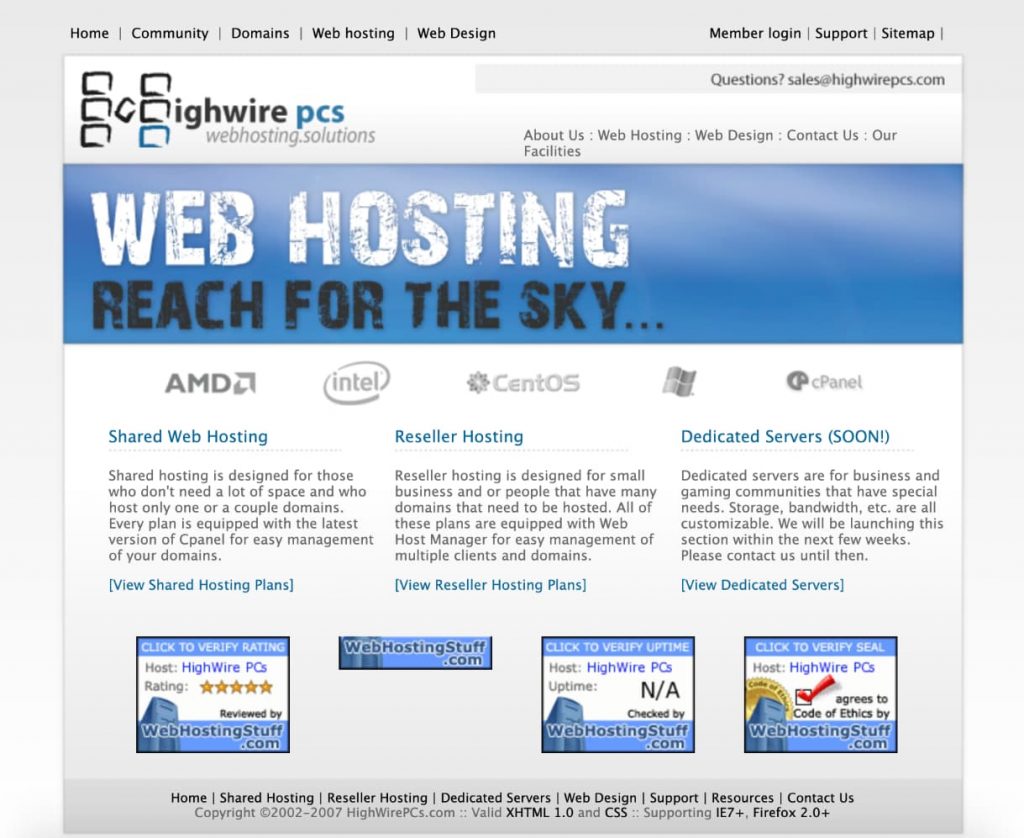
I spent my weekends and nights browsing forums and starting up conversations with people who were looking for hosting. Participating on Web Hosting Talk was, in fact, a big part of how I got a lot of my first customers. Basically, I was renting dirt-cheap servers and running WHM on them. I was throwing as many clients on to one box as I could to ensure the most profit possible.
Yes, I know, shame on me. I was helping create something which today I now despise: shitty shared hosting. To be fair though, this was before managed WordPress hosting was even a thing.

By the time I graduated high school, I had a couple of dedicated servers in a data center and was hosting over 700 domains, still under the “HighWire PCs” branding. I was off to a private University, and things were looking great! The sky was the limit, I thought.
Freshman year, I took a job at the HelpDesk at Walla Walla College (now Walla Walla University). Thankfully due to my network administrator job, I had learned some valuable skills. I pretty much knew the ins and outs of Novell and Active Directory.
Since the tuition cost was $30,000 per year, my hosting company profits weren’t going to cut it quite yet. And looking back now, taking that job was one of the best decisions I have ever made. Who knew I would be working there for six more years and gain work experience that was literally priceless.
But then things started to fall apart again. About halfway through my freshman year, I realized I couldn’t keep up with the support and maintenance of all my web hosting clients. Going to class full-time, working 30+ hours a week at the helpdesk, and managing my company late at night wasn’t working. I tried to hire outside help and failed miserably. I couldn’t figure out how to scale properly. So I ended up selling my company, HighWire PCs, along with all the clients.
Fourth failure (I cashed out too soon)
It wasn’t long after selling my company that my entrepreneur blood kicked back in. I think it was about a week lol. 😂 I always loved building websites, so I decided to start a blog where I could share what I was learning at my job at the University. By this time, I had moved into the role of PeopleSoft Security Administrator for the IT department. So I started the blog theitbros.com, along with my brother, who was also attending the same University.
Things were going great for a while. The IT blog was making money from Google AdSense, and I was enjoying blogging in the evenings.
Later that year, I packed up everything I owned and without a job lined up (risky I know), and moved to sunny Scottsdale, Arizona. 🌵 I had gotten sick of the constant rain and gloomy weather in Washington state. Fortunately, by the time I arrived in Scottsdale, I had a few job interviews and took a job at the HelpDesk at Partners Rx, a health insurance company.
An opportunity then came along, and I decided to sell theitbros.com on Flippa for $7,000. At the time, this seemed awesome. I had a few sites now, but getting over $7,000 for one was beyond exciting at the time!
However, fast forward a couple of years, and this turned out to be a huge mistake. Looking back now at all the time I had invested in it; I should never have given it up. Most people don’t realize, when it comes to niche authority sites, if you keep at it long enough, it’s almost impossible to fail. Obviously, there are exceptions to this, but I seriously undervalued my site and cashed out too soon.
One really cool thing that came out of working in the IT community (both online and offline) was that in 2013 I received the Microsoft MVP award in the Windows Expert-IT Pro category.

Fifth failure (striking out on my own didn’t work)
Working HelpDesk at Partners Rx soon got very tiring. It was pretty low pay for working a lot of hours. I remember still having to run back to the office many times because the VPN failed or the Exchange Server went down.
So I decided to strike out on my own and start Scottsdale Computing, a remote computer repair shop. Below is a photo of one of my business cards.

I had some money saved up for about six months’ worth of rent and expenses, so I wasn’t too worried at first. However, I hadn’t done my research. I soon found out that Scottsdale already had prominent players in the computer repair space, and it was almost impossible to break into it.
I started advertising online, and housecalls did start picking up here and there, but running around in the 100+ degree heat lugging computers back to my apartment to fix them soon got tiring.
I then decided that there was no way I was ever going to work IT again in my life (even though that was where most of my experience was). IT is stressful and exhausting. So once again, I failed.

First sign of success (but met with life hurdle)
My brother had recently moved to Arizona and was working as a web developer for a local company. I was looking for a new job and had always dabbled in marketing. After chatting with them, I took a job at Pain Doctor as their AdWords and SEO Specialist.
I was really excited. No more fixing shit, no more phone calls from clients at 10 PM. No more Exchange servers going down in the middle of the night. I was finally free!
A couple of weeks into the new job, I decided, of course, that I wanted to start blogging what I was learning. So I started blogging on brianjackson.io (the content is now on woorkup). It took a little work, but eventually, I hit 10,000 visitors a month without any advertising or backlink building (all organic).
I started to see something clicking, and a lightbulb kind of went off. 💡 Soon things at my job were showing huge results, and I started putting those things into practice on my own websites.
Fast forward one year, and brianjackson.io was getting over 35,000 visitors per month! Things were looking up. I had a good-paying job; I was finally figuring out what people wanted to read online and how Google worked. But nobody said life was easy. In 2014 I suddenly started having stomach pain. Long story short, I was diagnosed with Ulcerative Colitis, an incurable autoimmune disease.
It took me about a year to figure out that doctors weren’t going to be my savior. I finally went 100% gluten-free and have been ever since. This literally saved my life. So much so that I launched a site called No Gluten, where I blog about eating gluten-free. If you’re curious about my struggle with Ulcerative Colitis, you can read the extended version here: An Entrepreneur: Living with Ulcerative Colitis.
Things finally started working
I kept blogging on my personal domain and figured that I should move it to a business name. There are things to be said about personal branding, but what if I ever wanted to sell it down the road? Of course, being more careful this time about undervaluing it.
So I acquired the woorkup.com domain in 2015 and started sharing marketing strategies about SEO, SMM, WordPress, and web performance, along with in-depth SaaS reviews. I moved all my content from brianjackson.io, and 301’d it over to woorkup.com.
During this time, I realized I didn’t want to be sitting in a cubicle anymore. So I quit my day job, and after looking around online, I ended up with a remote position at KeyCDN as their Inbound Marketer. This was a great fit as it was easier to manage my health, and I got to do what I now loved: writing and SEO. Two things which I had become really good at throughout all these past failures.
Fast forward one more year to 2016, and I decided that WordPress was calling my name. I had always used WordPress for my own sites, so I was already used to using it on a daily basis. I was at that time hosting my sites at Kinsta and had gotten to know Mark, the CEO, and Tom through Skype. I was, in fact, one of Kinsta’s first customers.
Long story short, they were looking for someone to help take their marketing to the next level. I’m happy to say it was a perfect match from there on out. It was awesome to no longer sell shitty shared hosting, but a service I was really proud of. 👏 Not to mention the team at Kinsta is the best group of people you’ll ever meet.

Still dabbling with things on the side, in June 2016, my brother and I decided to go 50/50 business partners on everything and formed forgemedia LLC. We launched our first WordPress plugin, WP Coupons.
Fast forward a year, and we launched our second premium WordPress plugin, Perfmatters. If you’re interested to learn more about my niche site or things we learned during the launch of our plugins, here are a few posts you should check out:
- How I Took My Niche Site to 100k Visitors/Month + $1k/Month in 365 Days
- What we’ve learned from building and selling WordPress plugins (good and bad)
Sixth failure (burned out again)
You would think I would have learned by now, but come 2020 I realized I was about to completely burn out. Working for Kinsta was one of the best experiences of my life and I don’t regret it for a second. But due to my workaholic nature, all the late nights definitely took a toll on me.
As some of you may know, scaling a startup takes a lot of work. But I’m proud that I could help the team turn it into a brand people now know and love throughout the WordPress community.
Don’t get me wrong. I don’t view my time at Kinsta as a failure by any means, but I do in regards to me burning out. Looking back, are there things I could have done differently to prevent it? Sure, but my “go go go” personality got the best of me. You live and learn. This entire post is proof of that. Feel free to read more about why I left Kinsta.
I’m still a happy Kinsta user, and always will be. But in January 2020, I parted ways with them, and my brother and I started working full time on our own business, forgemedia LLC.
If you are curious about the timing, my brother was coincidentally also burned out at his job. According to a survey from community-workplace app Blind, nearly 60 percent of tech workers admitted to feeling burnout! Occupational burnout in the tech industry is more of a problem than most people realize and many don’t even talk about it.
Summary
I’m happy to say that 2019 was our best year yet in terms of income from our sites and plugins. 2020 is already on track to significantly surpass the previous year.

The point of this post wasn’t to gloat. It was to show that not all internet marketing success comes overnight, as some might have you believe. If you read the backstories of many of the successful internet marketers you follow today, you’ll most likely discover that they’ve been hustling at it for years.
In my 19+ years of hustling, I’ve learned that being consistent is how you become successful. 🤘 And yes, it’s hard work.Click to PostIf I was to use a video game analogy, I would say that being an entrepreneur is like playing World of Warcraft. Unfortunately, the enjoyable part is leveling from 1-30 (starting a new idea/project). But reaching level 90 (the end game) takes a lot of hard work, consistency, and focus.
One of the biggest challenges with entrepreneurs is their inability to focus.
Tony Perez, Co-Founder of Sucuri (source)
It took me nineteen years of failure to finally figure out how internet marketing works, or at least a way to make good money from it. Without all of these failures, I wouldn’t have the knowledge I do today and also, wouldn’t appreciate it as much. So instead of saying failures, I like to view them as priceless learning experiences.
For some of you younger folks, it might not take as long to get to where you want to be. Remember, I started back in the days of dial-up and Windows 98/XP. Everything moved slower back then. Today you have the entire internet at your disposal with an unlimited source of knowledge.
If you’re currently struggling to make that first dollar online or the first $100 a day mark, just keep at it. It’s possible, and I can tell you it’s worth the wait. But remember to also pace yourself! I’ve unfortunately burned out multiple times throughout my career. Staying healthy, getting lots of sleep, is more important than you might realize. You aren’t a robot, and our bodies can only take so much.
Internet marketing is the best job in the world! But remember to pace yourself. You aren’t a robot 🤖 and burnouts take their toll.Click to PostI would love to hear your thoughts. Have you failed over and over again online like me? Have you burned out? Share what you’ve learned below in the comments.

Wow! Your story inspires me! I too faced many failures past 6 years.
:)
Thanks Rushikesh! Failures help make us stronger and wiser.
Hey Brian – I have always enjoyed your articles and content (mainly wp and kinsta stuff before). This one was awesome too – thanks for sharing all this – bookmarked!
Glad to hear it Steven! Comments like these are what keep me writing :)
Really inspiring Brian! Keep posting…
Thanks Tarannum, glad you like it!
Hey Brian,
You’ve already gone through so much and I admire how you kept thinking of new ideas and working on it day/night.
And Pennybros.com shows how intrigued you’re with the word “bros”
Keep shining.
Thanks Shafi! Never stop hustling. Haha, and yes… for some reason a couple of our projects have included the term “bros.” My brother and I tend to be two peas in a pod… marketing/SEO + coding.
Great article Brian.
It inspires me to start blogging again, but it’s so hard to find any additional time to what I have now.
Thanks Kris! You should, but totally understand the time constraints. Blogging takes a lot of time.
Thanks for the motivative article Brian.
I have been failing since 2014 in blogging, changing from niche to niches with one particular domain, but now i think i have found a good niche for myself.
I am highly motivated to continue working on my blog, and now i believe so much in it once again
Thanks once again Brian… you’re a real hustler
Thanks Doronize,
Glad my post was of some inspiration. Ya niche blogging can be very hard as sometimes you have to continue to fail (even after researching) until you find one that works really well. Sounds like you’re on the right track. Keep at it!
Hey. May i know the inspiration behind the word “Woorkup”. does it stand for “work up” or what was the thought process behind it.
Really inspiring work. I am a fan of perfmatters plugin.
Hey Hitesh!
So I acquired the woorkup.com domain as it had some authority behind it already. So I didn’t create the word woorkup. But I link to think of it has “work smart” or always work with the idea of moving forward/up.
Glad you like the perfmatters plugin. You’re probably gonna love the next feature we are launching. I won’t give it away, but it’s a great one.
I love your story and am on a similar path, different track. I have to say, I was chuckling because you talk about doing stuff on dial-up. I wish I had that AND eBay when I was a kid.
Cheers
Probably one of the best contents I’ve read this month.
Thanks for this Brian!
Thanks Sebastian, that means a lot!
You’ve already gone through so much and I admire how you kept thinking of new ideas and working on it day/night.
A truly inspiring story :)
Our biggest fault is that we underestimate our power. We should never underestimate our own potential.
That gif on free money made me laugh. Actually I can relate that with one of mine incident. ;)
Thanks for sharing your valuable experience.
I can relate to this so much. My blogging journey has been filled with many ups and downs. There have been times where I lost passion for writing. There have even been times where I had to start my blog over due to my SEO being affected. Bloggers such as yourself and Neil Patel push me to keep on going when it gets tough. Thank you for your continuous inspiration.
It’s amazing how much of success relies on time. I’ve found that no matter what I’ve done, it’s always been about making mistakes and then getting better at it over time.
Hey Blake!
Making mistakes is so important. My best advice to anyone is to just start making the mistakes as soon as you can. The sooner you learn what doesn’t work, the sooner you’ll find what does.
Hello! Your post was amazingly good and very inspirational.
Great Work!
Thanks for sharing your story, Brian!
Hey Brian, thanks for being so honest here. Honestly, these aren’t even as bad as mine. You have actually made really smart decisions and you are really good at learning from your mistakes.
Thanks for sharing!
Ike
Thanks for your value articles. Same with me these mistakes almost 8 years when I start build business and startup around internet.
p/s: can you share with me where you get these cute thumbnail photos :) I really love it!
Hey Kimi!
I use Iconfinder. I even wrote a review about them: https://woorkup.com/icon-sets-iconfinder/
Where are the failures? If you had invested a ton of money (or time) that was ultimately a loss then that’s a failure – unless you derived new skills or knowledge. You made money from your endeavors and your employment. You took initiative to build something and it worked for a period of time. Schooling limits time, the internet evolved impacting every business, life and health are unpredictable and you made choices to move on when something was not sustainable or for other personal/business reasons. You took initiative, demonstrated followed through and course corrected when necessary. That isn’t failure – that’s an evolving journey. Thank you for sharing this great personal story!
Hey Mark!
I totally agree that failure can also be a success at the same time. What I learned from each failure is invaluable, and as you said, I did earn money along the way.
You’ve always been a hard worker. Which is why I pretty much appreciate everything you do. But I do agree, sometimes it sucks. I work ridiculously hard and it pays off but it takes a lot too. Consistency is super hard. Keep it coming :)
Peace! ✌️
Hey Ahmad!
Thanks, I agree it can be super hard to be consistent. But definitely pays off!
Thank you for sharing. Our CEO, Nathalie Lussier (AccessAlly) also started her first business very young. Her lessons learned from her younger days have greatly helped her build our team to what we are! Thanks for sharing, it’s not always glitz and glamor but innovation is always there!
Great post! It was a great encouragement to me. I just started with digital marketing job and still have a lot of time to experience failures. ^^
Amazing post, Brian! It reminds me of all the businesses I had and all failures of course! Very inspiring!
Thanks, glad you could relate!
Hi Brian!!! You are great man. I read your story and i am fully inspired.
Well written, Brian! It has been awhile since RiseForums, but I’m amazed with your progress. It is an inspiration!
Thanks Leo!
I love how you talked about your failures and shared what exactly went wrong.
I’m also very interested in your partnership with your brother. That’s awesome. I’m a solo entrepreneur for my businesses but looking to bring on a partner as well.
How would you go about bringing on a close friend as a partner into an existing business? I don’t feel like giving up 50% of it since I grew it to this point. But also want to give enough where he has enough skin in the game. Would you give 50% anyways? Thanks again Brian and looking forward to more update posts like this one :)
Hey Katie!
Sorry for the delay in responding to your comment.
Yes, my advice is to find a partner with skills you don’t have. That is how the partnership with my brother is structured. I do the marketing, which is what I’m good at, and he does development work. He was a full-time WordPress developer prior to our business. So our skill sets complement each other very well.
Picking a partner can be hard, and you’re right. You want to make sure they have enough skin in the game. I gave my brother 50% after already having this site well established. So it was an investment on my part for sure, as I had put hundreds of hours into writing content already. But it was the right choice in my case as there are things I wouldn’t have been able to accomplish without him.
Perhaps you have already found a partner by now. Hope things are going well!
In my entrepreneurship journey, I’ve learned one thing. You can’t be an entrepreneur unless you encounter failures and problems.
Hey John!
I agree. Failures and figuring out how to successfully overcome them is a big part of being an entrepreneur.
Long time no talk Brian glad you are cruisin’! Keep it up!
Hey Chris! Yes, it’s been a while since we’ve chatted. Hope everything is going well for you during these crazy times.
Hi Brian,
Will you write the SEO book you mentioned on Twitter? I am interested in your SEO book.
I have a question. During the time you worked with Kinsta, did you build backlinks to Kinsta actively, or did you just focus on writing great content and promoting it on social media, and only acquire natural backlinks?
Hey Jakab,
Yes, I am planning on writing an ebook about SEO, but not sure how long it will take.
Regarding your question involving backlinks. We did have someone that helped reach out to people regarding our content. For example, if we mentioned a brand or person in an article, we made sure to let them know. However, I never personally spent time building backlinks. In fact, I have a whole article about that here: https://woorkup.com/quality-content/
You can easily build entire brands and traffic without backlinks if you focus all your time on quality content. Backlinks are important but nowhere near as important as the content itself. Make your content awesome and something that people want to link to on their own. That’s where I focus my energy.
Write a book, as long as it is valuable and full on evergreen SEO strategies, we will buy it. I have written a linkedin marketing book, and now about to finish my SEO ebook. Thanks Brian, your blog is very informative.
Hey Daniel! Thanks for the feedback. I took a poll on Twitter a month or so ago about writing an SEO ebook, and the feedback I got was overwhelmingly positive. So I’m already planning to do this.
Thanks for this article. Good work. Keep moving.